

Working principle of mobile phone chip core
Overview
Dual PD, also known as Full Pixel Dual-Core Autofocus, features an innovative pixel structure design:
Microstructure
Traditional image sensors typically have only one photodiode (PD) under each pixel. In contrast, Dual PD technology integrates two independent photodiodes (left PD and right PD) beneath the microlens (OCL) of each pixel.
Phase Detection
These two side-by-side PDs can receive light from slightly different angles, much like human eyes, thereby detecting the phase difference of incident light. By calculating the offset and direction between the two images, the system can instantly and accurately determine whether the focus is in front of or behind the target, as well as the exact distance the lens needs to move to achieve precise focus.
Integration of Imaging and Focusing
During final imaging, the signals generated by the two PDs are combined and read as a single, complete pixel signal. This means every pixel undertakes both focusing and imaging tasks simultaneously, enabling full-pixel participation in phase detection autofocus—thus achieving high-speed focusing while maintaining image quality.
Phase Detection
These two side-by-side PDs can receive light from slightly different angles, much like human eyes, thereby detecting the phase difference of incident light. By calculating the offset and direction between the two images, the system can instantly and accurately determine whether the focus is in front of or behind the target, as well as the exact distance the lens needs to move to achieve precise focus.
Integration of Imaging and Focusing
During final imaging, the signals generated by the two PDs are combined and read as a single, complete pixel signal. This means every pixel undertakes both focusing and imaging tasks simultaneously, enabling "full-pixel" participation in phase detection autofocus—thus achieving high-speed focusing while maintaining image quality.
Based on the above principles, Dual PD technology offers several distinct advantages:
1. Ultra-fast Focusing
Unlike contrast-detection autofocus, which "hunts" back and forth to find the focus, Dual PD directly calculates the optimal focus position. This results in an extremely fast focusing speed, with the quickest response reaching 0.03 seconds.
2. Excellent Low-light Performance
With 100% of pixels participating in focusing, the density of phase detection points reaches 100%. Even in dim lighting conditions (e.g., as low as -4 EV), sufficient phase information can be captured to ensure stable autofocus.
3. Lossless Image Quality
Traditional masked PDAF reserves some pixels exclusively for focusing; these pixels do not contribute to imaging and require interpolation compensation using information from surrounding pixels, which causes slight image quality degradation. Dual PD technology eliminates the need for dedicated focus pixels—all pixels output complete signals during imaging, thus avoiding this issue and preserving the clarity and purity of the image.
Dual PD serves as a foundational solution. To adapt to sensors of different sizes and requirements, the industry has developed a range of more advanced technologies. The table below compares several mainstream full-pixel autofocus technologies:
Technical Solution | core structure | Main Features | Typical application scenarios |
Dual PD | 1 micro lens corresponds to 2 photodiodes | The basic form of full pixel AF provides excellent focusing performance and image quality. | Smaller size sensors |
2×2 OCL | 4 pixels of the same color share 1 microlens | Improved photoelectric conversion efficiency, sensitive to lines in all directions. But the intrinsic resolution is equivalent to that of a regular Bayer sensor. | Medium sized sensors (such as 1/1.56 type) |
Octa PD | Combining Dual PD with Quad Bayer structure, equivalent to 8 PDs working together | The focusing performance is extremely strong, especially in HDR shooting, but the structure is complex. | Large sensors (such as flagship phone main camera IMX989) |
Dual PD technology successfully achieves simultaneous phase detection, focusing, and imaging for all pixels through the clever design of integrating two photodiodes within each pixel and sharing micro lenses. This not only solves the traditional problem of balancing focusing speed and image quality, but also brings a leap forward to the autofocus experience of devices such as smartphones and digital cameras, and has given rise to more advanced solutions such as 2 × 2 OCL and Octa PD.
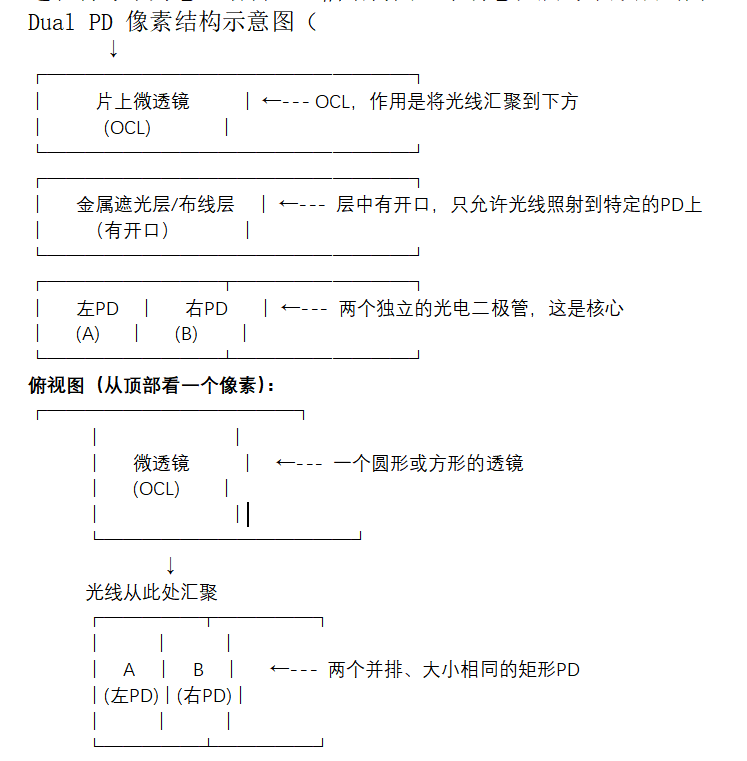
Intuitive Explanation of the Working Principle
1. Viewpoint Difference (Similar to Human Eyes)
The left photodiode (PD-A) has a metal layer opening offset to the right above it, so it mainly "sees" and receives light from the right side. By contrast, the right photodiode (PD-B) mainly "sees" and receives light from the left side. This creates a slight difference in viewing angles, just like the subtle disparity between the images perceived by the left and right human eyes.
2. Phase Detection
When the focus is accurate, light emitted from the same position of the lens illuminates both PD-A and PD-B perfectly and evenly, generating electrical signals of equal intensity. At this point, the phase difference is zero, indicating a successful focus lock.
When the focus is inaccurate (e.g., the focal point lies in front of the sensor), light from the same object will hit PD-B (the right photodiode) first before reaching PD-A (the left photodiode). This causes the signals from PD-A and PD-B to differ in strength and creates a "misalignment" distance. This misalignment is the phase difference.
By calculating this phase difference, the system can instantly determine the direction and distance the lens needs to move to achieve precise focus.
3. Combined Imaging
After the focus is achieved, the signals from PD-A and PD-B are summed to form the final brightness value of the pixel. This yields a complete image signal without any loss of information.
Structure of Dual PD
Beneath a single microlens, two independent photodiodes (PDs) are placed side by side. Like a pair of twins, they observe the world from slightly different angles, collaborating not only to achieve fast autofocus but also to jointly deliver high-quality image output.